HamiIT
Sign inGet started
Home
ADD CONTENT

Sign in Required

Please sign in to add content

Sign In
ProgramsBsc CSITSemester 4Theory of Computation Unit II: Introduction to Finite Automata (8 Hrs.)
Chapter Study

Bsc CSIT Semester 4 – Theory of Computation – Unit II: Introduction to Finite Automata (8 Hrs.)

Comprehensive questions and detailed answers for Unit II: Introduction to Finite Automata (8 Hrs.). Perfect for exam preparation and concept clarity.

12
Questions
95
Marks
Back to All Chapters
1

Define the NFA with ε-transition and ε-closure of a state. Show that for every regular expression r, representing a language L, there is ε-NFA accepting the same language. Also convert regular expression (a+b)ab into equivalent Finite Automata.

HardNumerical10 marks2076(TU Final)
2

Give the formal definition of DFA. Construct a DFA accepting all strings of {0, 1} with even number of 0’s and even number of 1’s.

MediumTHEORY5 marks2076(TU Final)
3

Construct a NFA accepting language of {0, 1} with each string ending with 01 and convert it into equivalent DFA.

MediumTHEORY5 marks2076(TU Final)
4

Give the formal definition of DFA and NFA. How NFA can be converted into eqivalent DFA? Explain with suitable example.

HardTHEORY10 marks2078(TU Final)
5

Find the minimum state DFA for the given DFA below:

StatesInput
01
ABF
BEC
CBD
*DEF
EBC
FBA
HardTHEORY10 marks2078(TU Final)
6

Show that, For any NFA N=(Q, ∑, δ, q0, F) accepting language L=∑, There is a DFA D= (Q’, ∑’, q0′, δ’, F’) accepting the same language L.

HardTHEORY10 marks2079(TU Final)
7

State and prove the Pumping Lemma for regular languages. How can you show with example that pumping lemma is used to prove that a given language is not a regular? Explain.

HardTHEORY10 marks2079(TU Final)
8

Explain the ε-closure of states on an ε-NFA with suitable examples.

MediumTHEORY5 marks2079(TU Final)
9

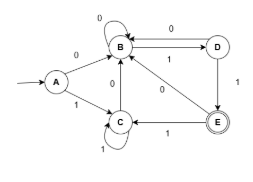
What is NFA? How is it different from DFA? How is NFA to DFA conversion done? Convert the following NFA into DFA. image

HardTHEORY10 marks2080(TU Final)
10

Design a DFA that accepts single line and multi-line comments of the C-Language.

MediumTHEORY5 marks2080(TU Final)
11

Describe the extended transition function of NFA. Construct a NFA, using transition table and transition diagram , over {0, 1} that accept the string having substring 01 and ends with 1. Show the acceptance of 0111.

HardTHEORY10 marks2080(TU Final)
12

Design a Melay machine over {a, b} that generates output ‘A’ if the input string ends with aa else output ‘B’ if the string ends with bb.

MediumTHEORY5 marks2080(TU Final)
Showing 12 questions

Exam Years

Past question papers

2080
TU Final•2 questions
2080
TU Final•2 questions
2079
TU Final•3 questions
2078
TU Final•2 questions
2076
TU Final•3 questions

Questions in Unit II: Introduction to Finite Automata (8 Hrs.)

Define the NFA with ε-transition and ε-closure of a state. Show that for every regular expression r, representing a language L, there is ε-NFA accepting the same language. Also convert regular express

Marks: 10

Year: 2076 Final TU

ε–NFA, ε–Closure, and Regular Expression Conversion Definition of ε–NFA An ε–NFA (Epsilon Non-Deterministic Finite Automaton) is defined as a 5–tuple: M = (Q, Σ, δ, q₀, F) Where: - Q → Finite set of

Give the formal definition of DFA. Construct a DFA accepting all strings of {0, 1} with even number of 0’s and even number of 1’s.

Marks: 5

Year: 2076 Final TU

Definition (DFA) A Deterministic Finite Automaton is a 5-tuple M = (Q, Σ, δ, q₀, F) where: - Q is a finite set of states. - Σ is a finite input alphabet. - δ: Q × Σ → Q is the transition function (det

Construct a NFA accepting language of {0, 1} with each string ending with 01 and convert it into equivalent DFA.

Marks: 5

Year: 2076 Final TU

Step 1: Description We need a machine that accepts all binary strings that end with "01". That is, L = { w ∈ {0,1} | w ends with 01 }. --- Step 2: NFA Construction An NFA can nondeterministically g

Give the formal definition of DFA and NFA. How NFA can be converted into eqivalent DFA? Explain with suitable example.

Marks: 10

Year: 2078 Final TU

1. Deterministic Finite Automaton (DFA) A Deterministic Finite Automaton (DFA) is a mathematical model of computation that accepts or rejects strings over an input alphabet. A DFA is formally defined

Find the minimum state DFA for the given DFA below: | States | Input | | |--------|-------|---| | | 0 | 1 | | A | B | F | | B | E | C | | C | B | D | | D |

Marks: 10

Year: 2078 Final TU

Formal Definition of DFA A Deterministic Finite Automaton (DFA) is a 5-tuple M = (Q, Σ, δ, q₀, F) where: 1. Q = finite set of states 2. Σ = input alphabet 3. δ : Q × Σ → Q = transition function

Show that, For any NFA N=(Q, ∑, δ, q0, F) accepting language L=∑, There is a DFA D= (Q’, ∑’, q0′, δ’, F’) accepting the same language L.

Marks: 10

Year: 2079 Final TU

For any NFA $N=(Q,\Sigma,\delta,q0,F)$ that accepts language $L(N)=\Sigma^$, there exists a DFA $$D=(Q',\Sigma,q0',\delta',F')$$ such that $L(D)=L(N)=\Sigma^$. --- 1. Construction of the DFA (5 m

State and prove the Pumping Lemma for regular languages. How can you show with example that pumping lemma is used to prove that a given language is not a regular? Explain.

Marks: 10

Year: 2079 Final TU

1. Statement of the Pumping Lemma for Regular Languages (2 marks) Let $L$ be an infinite regular language. Then there exists an integer $p\ge 1$ (called the pumping length) such that for every string

Explain the ε-closure of states on an ε-NFA with suitable examples.

Marks: 5

Year: 2079 Final TU

ε-Closure of States in an ε–NFA (Exam-style Answer) In an ε–NFA (Epsilon–NFA), transitions can occur without consuming any input symbol, i.e., on ε (epsilon). To handle such automata, the concept of

What is NFA? How is it different from DFA? How is NFA to DFA conversion done? Convert the following NFA into DFA.

Marks: 10

Year: 2080 Final TU

1. What is NFA? (2 Marks) A Nondeterministic Finite Automaton (NFA) is a 5-tuple: \[ N = (Q, \Sigma, \delta, q0, F) \] where, - \(Q\): set of states - \(\Sigma\): input symbols - \(\delta\):

Design a DFA that accepts single line and multi-line comments of the C-Language.

Marks: 5

Year: 2080 Final TU

Alphabet (classes): /, , \n (newline), other (any char ≠ /,,\n) Informal language: exactly one C comment — either a single-line //... (until end) or a closed multi-line / ... / (no nesting). States (s

Describe the extended transition function of NFA. Construct a NFA, using transition table and transition diagram , over {0, 1} that accept the string having substring 01 and ends with 1. Show the acce

Marks: 10

Year: 2080 Final TU

1. Extended transition function of an NFA (δ) For an NFA \(N=(Q,\Sigma,\delta,q0,F)\) the extended transition function \(\delta^: Q \times \Sigma^ \to \mathcal P(Q)\) is defined recursively to describ

Design a Melay machine over {a, b} that generates output ‘A’ if the input string ends with aa else output ‘B’ if the string ends with bb.

Marks: 5

Year: 2080 Final TU

Concept A Mealy Machine gives output on transitions, not on states. To check last two input symbols, the machine must remember the previous symbol. --- Mealy Machine Components - Input alphabet (Σ)

About Unit II: Introduction to Finite Automata (8 Hrs.) Questions

This page contains comprehensive questions from the Unit II: Introduction to Finite Automata (8 Hrs.) chapter of Theory of Computation , part of the Bsc CSIT Semester 4 curriculum. All questions include detailed model answers from past TU exam papers.

Study Tips

  • Review concepts before attempting questions
  • Practice writing complete answers
  • Compare your answers with model solutions
  • Focus on questions from recent years
  • Use direct links (#question-ID) to bookmark and share specific questions

Related Resources

← Back to Theory of Computation Chapters

Unit II: Introduction to Finite Automata (8 Hrs.) chapter questions with answers for Theory of Computation (Bsc CSIT Semester 4). Prepare for TU exams with our comprehensive question bank and model answers.

H
Hami IT

Empowering IT students with quality education resources and comprehensive exam preparation materials.

Programs

  • Flutter
  • Java
  • DevOps

Company

  • About Us
  • Contact

Contact

  • 📧hamiit.dev@gmail.com
  • 📞+977 9813706443
  • 📍Kathmandu, Nepal

© 2026 Hami IT. All rights reserved.