HamiIT
Sign inGet started
Home
ADD CONTENT

Sign in Required

Please sign in to add content

Sign In
ProgramsBCASemester 1Digital LogicUnit 5 Sequential Logic Design
Chapter Study

BCA Semester 1 – Digital Logic – Unit 5 Sequential Logic Design

Comprehensive questions and detailed answers for Unit 5 Sequential Logic Design. Perfect for exam preparation and concept clarity.

14
Questions
115
Marks
Back to All Chapters
1

Design MOD-7 counter with state and timing diagram.

MediumTHEORY5 marks2019(TU FOHSS Final)
2

Distinguish between sequential and combinational logic with example? Discuss the design procedure of combinational logic.

HardTHEORY10 marks2019(TU FOHSS Final)
3

A sequential circuit with two D flip flops, A and B, two inputs x and y, and one output z, is specified by the following next state and output equations.A(t+1)=x′y+xAB(t+1)=x/B+xAz=B. A(t + 1) = x'y + xAB(t + 1) = x/B + xAz = B.A(t+1)=x′y+xAB(t+1)=x/B+xAz=B.

  1. Draw the logic diagram.
  2. Derive the state
HardTHEORY10 marks2019(TU FOHSS Final)
4

Write short Notes on (any Two):

a) Parallel Adder

b) PLA

c) State Diagram

MediumTHEORY5 marks2020(TU FOHSS Final)
5

Differentiate between asynchronous and synchronous sequential circuits with example. Draw a block diagram, truth table and timing diagram to store 2001 in 4-bit SIPO register.

HardTHEORY10 marks2020(TU FOHSS Final)
6

Define counter. Write a procedure to design a counter circuit. Design MOD-8 up counter.

HardTHEORY10 marks2020(TU FOHSS Final)
7

Differentiate between synchronous and asynchronous counter. Design 3-bit up ripple counter.

MediumTHEORY5 marks2021(TU FOHSS Final)
8

What is counter? Design a mod 7 synchronous counter with state table, state diagram, circuit diagram.

HardTHEORY10 marks2021(TU FOHSS Final)
9

Differentiate between synchronous and ripple counter. Design mod 7 ripple counter with its state diagram, sequence table, logic diagram and timing diagram.

MediumTHEORY5 marks2022(TU FOHSS Final)
10

What is state diagram? A sequential circuit with two D flip-flops A and B, one input x and one output z is specified by the following next state and output equations:

A(t+1)=A′+B,B(t+1)=B′x,z=A+B′A(t + 1) = A' + B, B(t + 1) = B' x, z = A + B'A(t+1)=A′+B,B(t+1)=B′x,z=A+B′

i) Draw the logic diagram of the circuit ii) Draw the state table iii) Draw the state diagram

HardTHEORY10 marks2022(TU FOHSS Final)
11

Explain ring counter. Design a 3-bit asynchronous up counter with block diagram, count sequence table, and timing diagram.

HardTHEORY10 marks2023(TU FOHSS Final)
12

Explain the design procedure of a clocked sequential circuit. Design a clocked sequential circuit whose state diagram is given in the figure. image

HardTHEORY10 marks2023(TU FOHSS Final)
13

Write short notes on (any two):

a) State reduction table 
b) Multiplexer
c) Synchronous and Asynchronous counter

MediumTHEORY5 marks2024(TU FOHSS Final)
14

Explain shift register with parallel load. Design a synchronous Mod-10 counter to count in the sequence 0,2,4,5,6,8 using T flip-flops.

HardTHEORY10 marks2024(TU FOHSS Final)
Showing 14 questions

Exam Years

Past question papers

2024
TU FOHSS Final•2 questions
2023
TU FOHSS Final•2 questions
2022
TU FOHSS Final•2 questions
2021
TU FOHSS Final•2 questions
2020
TU FOHSS Final•3 questions
2019
TU FOHSS Final•3 questions

Questions in Unit 5 Sequential Logic Design

Design MOD-7 counter with state and timing diagram.

Marks: 5

Year: 2019 Final TU FOHSS

MOD-7 Counter Definition: A MOD-7 counter is a counter that counts from 0 to 6 (7 states) and then resets to 0. Type: - Can be synchronous or asynchronous. - Requires 3 flip-flops (since 2³ = 8

Distinguish between sequential and combinational logic with example? Discuss the design procedure of combinational logic.

Marks: 10

Year: 2019 Final TU FOHSS

1. Difference between Combinational and Sequential Logic | Feature | Combinational Logic | Sequential Logic | |---------|------------------|----------------| | Definition | Output depends only on curr

A sequential circuit with two D flip flops, A and B, two inputs x and y, and one output z, is specified by the following next state and output equations.\( A(t + 1) = x'y + xAB(t + 1) = x/B + xAz = B.

Marks: 10

Year: 2019 Final TU FOHSS

1. Given Sequential Circuit - Flip-Flops: D-type (A and B) - Inputs: x, y - Output: z - Next State Equations: \[ A(t+1) = x'y + xAB \] \[ B(t+1) = x'B + xAz \] \[ z = B \] --- 2. Step 1: De

Write short Notes on (any Two): a) Parallel Adder b) PLA c) State Diagram

Marks: 5

Year: 2020 Final TU FOHSS

a) Parallel Adder - A Parallel Adder is a combinational circuit that adds two binary numbers of n bits simultaneously. - Uses n full adders connected in series; each adder adds corresponding bits al

Differentiate between asynchronous and synchronous sequential circuits with example. Draw a block diagram, truth table and timing diagram to store 2001 in 4-bit SIPO register.

Marks: 10

Year: 2020 Final TU FOHSS

1. Difference Between Asynchronous and Synchronous Sequential Circuits | Feature | Asynchronous Sequential Circuit | Synchronous Sequential Circuit | |---------|-------------------------------|-------

Define counter. Write a procedure to design a counter circuit. Design MOD-8 up counter.

Marks: 10

Year: 2020 Final TU FOHSS

1. Definition of Counter - A counter is a sequential circuit that counts the number of clock pulses applied to it. - Counters can store and display the count in binary or decimal. - Types: Up coun

Differentiate between synchronous and asynchronous counter. Design 3-bit up ripple counter.

Marks: 5

Year: 2021 Final TU FOHSS

1. Difference between Synchronous and Asynchronous Counters | Feature | Synchronous Counter | Asynchronous (Ripple) Counter | |---------|------------------|-----------------------------| | Clock Input

What is counter? Design a mod 7 synchronous counter with state table, state diagram, circuit diagram.

Marks: 10

Year: 2021 Final TU FOHSS

1. Definition of Counter - A counter is a sequential circuit that counts clock pulses and produces a binary output representing the number of pulses. - Types: - Asynchronous (Ripple) Counter: Fl

Differentiate between synchronous and ripple counter. Design mod 7 ripple counter with its state diagram, sequence table, logic diagram and timing diagram.

Marks: 5

Year: 2022 Final TU FOHSS

1. Difference Between Synchronous Counter and Ripple (Asynchronous) Counter | Feature | Synchronous Counter | Ripple (Asynchronous) Counter | |--------|----------------------|-------------------------

What is state diagram? A sequential circuit with two D flip-flops A and B, one input x and one output z is specified by the following next state and output equations: \[ A(t + 1) = A' + B, B(t + 1) =

Marks: 10

Year: 2022 Final TU FOHSS

1. Definition: State Diagram - A state diagram is a graphical representation of a sequential circuit. - Shows all possible states of the circuit, transitions between states based on inputs, and corr

Explain ring counter. Design a 3-bit asynchronous up counter with block diagram, count sequence table, and timing diagram.

Marks: 10

Year: 2023 Final TU FOHSS

1. Ring Counter A ring counter is a type of shift register where the output of the last flip-flop is fed back to the input of the first flip-flop. Key Features: - Only one flip-flop is high at a time;

Explain the design procedure of a clocked sequential circuit. Design a clocked sequential circuit whose state diagram is given in the figure.
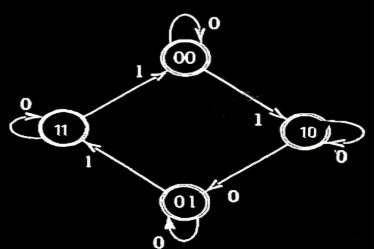
Marks: 10

Year: 2023 Final TU FOHSS

1. Understanding the Problem - Analyze the state diagram provided. - Identify the number of states and transitions. - Note input conditions and outputs for each transition. --- 2. Assign Binary Codes

Write short notes on (any two): a) State reduction table \ b) Multiplexer\ c) Synchronous and Asynchronous counter

Marks: 5

Year: 2024 Final TU FOHSS

a) State Reduction Table Definition: A state reduction table is used to minimize the number of states in a sequential circuit without changing its input-output behavior. Key Points: - Helps in sim

Explain shift register with parallel load. Design a synchronous Mod-10 counter to count in the sequence 0,2,4,5,6,8 using T flip-flops.

Marks: 10

Year: 2024 Final TU FOHSS

1. Shift Register with Parallel Load Definition: A shift register is a sequential circuit used to store and shift data. A shift register with parallel load can load multiple bits simultaneously in o

About Unit 5 Sequential Logic Design Questions

This page contains comprehensive questions from the Unit 5 Sequential Logic Design chapter of Digital Logic, part of the BCA Semester 1 curriculum. All questions include detailed model answers from past TU exam papers.

Study Tips

  • Review concepts before attempting questions
  • Practice writing complete answers
  • Compare your answers with model solutions
  • Focus on questions from recent years
  • Use direct links (#question-ID) to bookmark and share specific questions

Related Resources

← Back to Digital Logic Chapters

Unit 5 Sequential Logic Design chapter questions with answers for Digital Logic (BCA Semester 1). Prepare for TU exams with our comprehensive question bank and model answers.

H
Hami IT

Empowering IT students with quality education resources and comprehensive exam preparation materials.

Programs

  • Flutter
  • Java
  • DevOps

Company

  • About Us
  • Contact

Contact

  • 📧hamiit.dev@gmail.com
  • 📞+977 9813706443
  • 📍Kathmandu, Nepal

© 2026 Hami IT. All rights reserved.